
07 Nov 2026 · Troubleshooting
A kitchen exhaust that slowly gets worse with nothing changed is drifting: grease narrows the duct unevenly, the fan and its belt tire, filters get swapped for the wrong type, make-up air is blocked or borrowed, dampers and speed settings wander, or the menu has outgrown the hood. Turning the fan up hides it for a week. Check the filters, do the open-door test, find out when the system was last cleaned, and keep a dated monthly note so a technician has something to measure against.
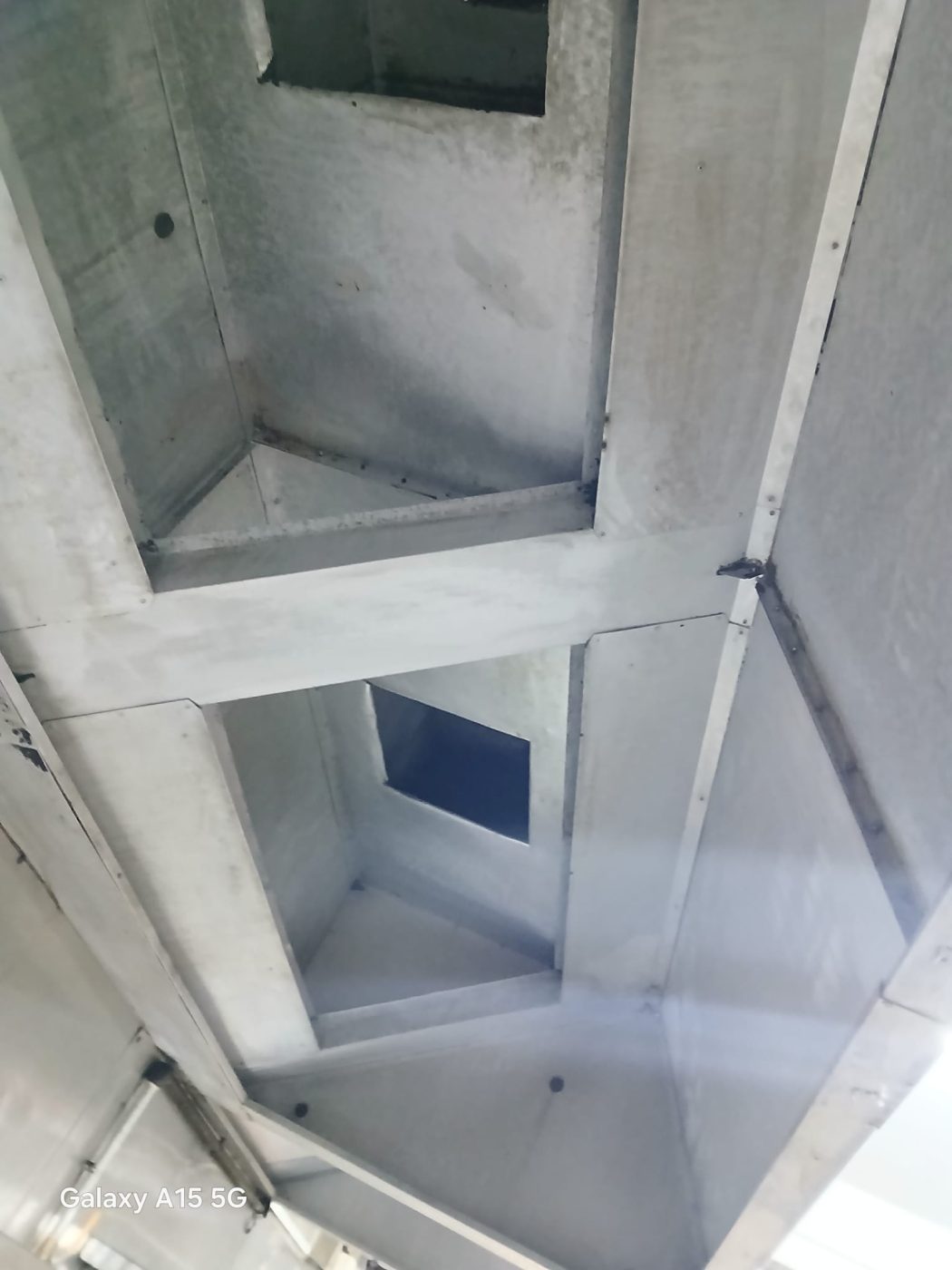
Pictured above: looking up inside a hood on one of BC Air’s projects (S Luck, Serangoon), at the openings where the air leaves the hood and goes into the duct. This is a photo from our own work, reused here because every one of the causes below changes how easily air gets through a space like this.
“Nothing has changed.” We hear it on almost every call about a kitchen that has slowly got worse. The smoke lingers a little longer at the end of the line. The cooks turn the fan speed up and stop noticing. The kitchen is hotter by mid-afternoon than it used to be. Nobody replaced the fan, nobody added a stove, nobody moved a wall, and so nobody connects it to anything.
Something did change. It changed one small step at a time, which is why no one saw it. A kitchen exhaust is not a thing that is set once and stays set. This post goes through what drifts on its own, how to tell a slow drift from a sudden fault, and the one-page habit that turns “it feels worse” into something a technician can measure.
The timeline narrows the cause faster than any tool.
1. Grease narrows the path, unevenly. Filters catch a share of the grease; some always gets past and coats the plenum, the duct, the fan blades and the inside of the canopy. Deposits narrow a section of duct, resistance rises, and the airflow falls. It only ever moves in one direction, and it rarely does so evenly: the branch serving the wok line fills faster than the one serving a steamer. Our published guidance is that most commercial kitchens need the exhaust cleaned every one to three months, monthly for heavy wok, grill and deep-frying kitchens. A kitchen that has crept from “fine” to “hot and smoky” with no other cause is very often a kitchen whose interval no longer matches what the line puts into the system. See the signs a hood is overdue for a deep clean.
2. The fan works harder for less air. Grease on the blades adds uneven weight and disrupts the airflow, and the motor compensates by drawing more and running hotter. On a belt-driven fan, a belt that has stretched slips and wastes airflow, and the change is invisible from the kitchen. Nobody sees the belt. They just see a hood that captures a little less each month. A new rattle, squeal or change in pitch is worth a call, and our note on how a dirty fan shows up in the energy bill explains why the two travel together.
3. Filters get replaced with “something that fits”. A damaged baffle filter swapped for mesh, a bank refitted with a gap, a filter put back reversed: each changes the resistance across the hood and therefore how much air it gets. Mesh holds the grease it captures instead of draining it, so it gets steadily more restrictive. If the filter bank today is not the one the hood was built with, that is a change, even if nobody remembers making it.
4. The make-up air path gets blocked or borrowed. The exhaust can only remove what comes back in. A make-up air grille that is clogged, a new partition, a door that is now kept shut, or one that is now kept propped open all change the pressure the hood is pulling against. The symptoms are the ones in our guide to make-up air and air balancing: doors that are hard to open, a kitchen that smells of drain, flames that will not sit steady.
5. Dampers and speed settings wander. A damper moved during a clean or a repair and not put back, a variable speed drive turned down at prep hours and never turned up again, a fan that was reversed during unrelated electrical work. On a system with several hoods, the effect lands on one hood while the others look fine; we go through it in several hoods on one duct, and when the balance drifts.
6. The kitchen changed around the hood. A new fryer under the old hood, a menu that now puts more oil into the air, longer hours, a pedestal fan on the line. The hood did not change, but what it has to do did. If the menu or equipment has moved since the hood was sized, the drift may not be in the system at all.
The instinct is to push harder. A higher speed on a fan that is fighting a greasy duct and a starved kitchen pulls more air out of a room that is already short of it, and the kitchen goes further into negative pressure. Doors get heavier, the hood captures less, and the kitchen pulls air from places you do not want it to. Turn-it-up works for a week and then it is part of the problem.
None of these needs tools, and none involves opening the duct or the fan housing. That stays with a technician.
“It seems weaker than it used to be” is an opinion. A dated note is a measurement. Once a month, at the same point in service, someone writes down four things on one page and files it with the cleaning reports:
Three months of those turn “nothing has changed” into a list. They fit naturally in the kitchen exhaust logbook, and they are what lets a technician compare the kitchen against a known state, not a memory. If the system was ever balanced or commissioned, the readings from that day are the baseline. If nobody can find them, the first measured set of readings becomes the baseline you compare against from then on.
Call when the cheap checks have not fixed it, when it has been getting worse for more than a few weeks, or when you cannot say when the system was last cleaned. A technician will look at the hood, the filters, the duct that can be reached, the fan and its drive, and the make-up air, and tell you which of the causes above applies. Where the problem is airflow rather than dirt, air balancing measures what the system is doing and adjusts it towards the figures it should hit. Where it is a worn part, kitchen exhaust repair covers motors, fans, fan parts and control panels. Where it is grease, it is a clean and a look at the interval.
We do not publish a price for this. It depends on what the inspection finds: how much deposit, which parts are worn, how many hoods share the fan and how accessible the dampers and grilles are. We assess the kitchen first and quote from what is there.
WhatsApp BC Air on 8989 2833 with the location, what you cook, what you are noticing and roughly since when, what has changed in the kitchen, and when the filters, duct and fan were last cleaned. Photographs of the hood from the front help. We are on 24/7 standby, and scope and pricing follow an inspection.
Related reading: signs your hood is overdue · make-up air and air balancing · the kitchen exhaust logbook
We design, clean, repair and maintain commercial kitchen exhaust systems across Singapore — on 24/7 standby.