
30 Sep 2026 · Maintenance
After a kitchen exhaust fan, motor or drive is replaced, a fan that runs is not proof the system moves the right air. Confirm the direction of rotation, read the motor current against its nameplate, record belt, pulley or drive speed settings, measure the airflow after the change, and re-check make-up air and interlocks, then get all of it in a dated report.
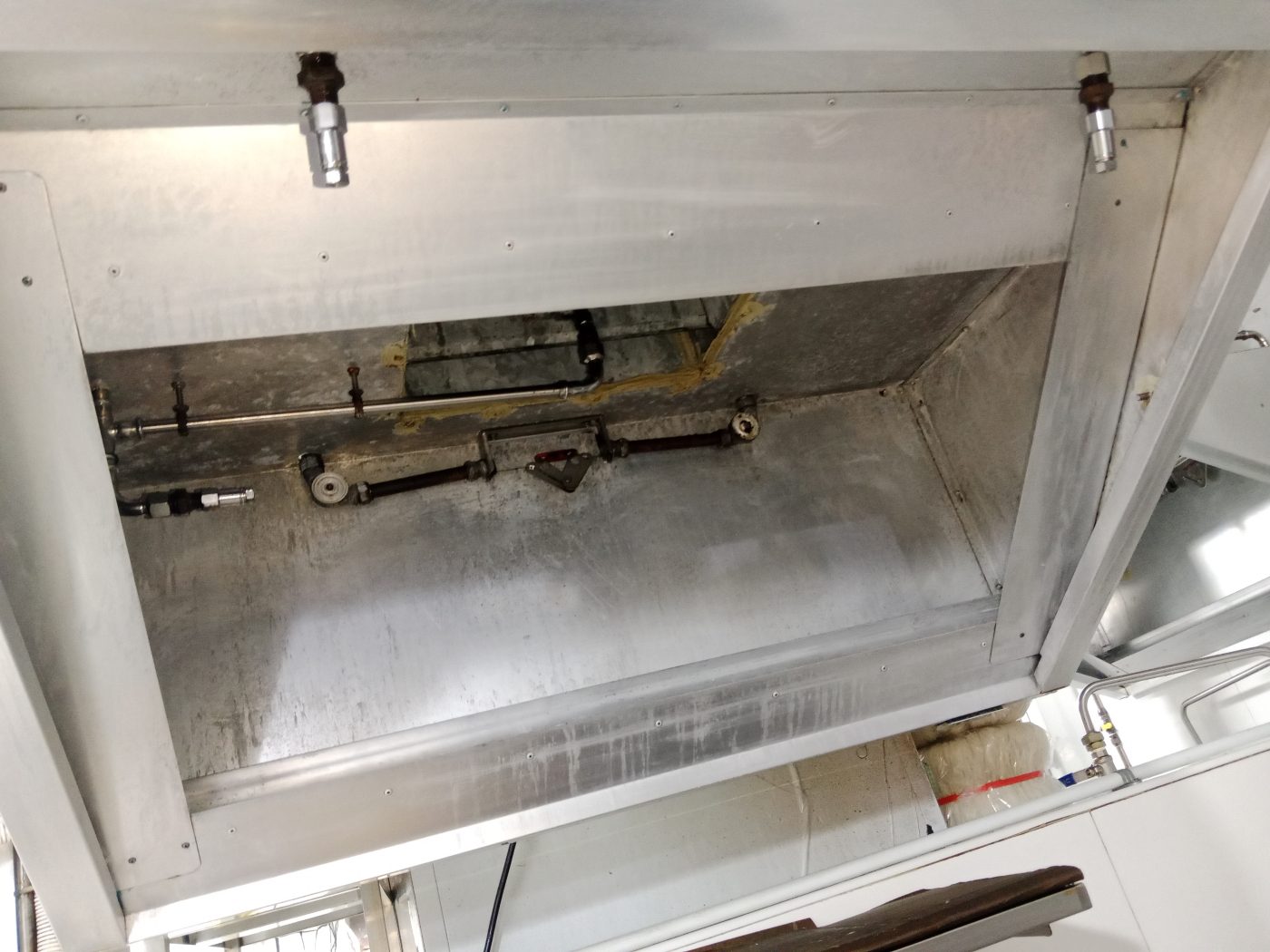
Pictured above: the inside of a hood canopy from one of BC Air’s jobs — the pipework that runs along the back and top edge above the cooking line. A fan change happens well away from here, at the roof or plant room, which is why its effect on the hood is so easy to leave unchecked.
When an exhaust fan, its motor or its variable speed drive is replaced, the job is usually scoped as “replace the part and confirm it runs.” It runs, the technician leaves, and the kitchen cooks the next service. What nobody has answered is the question that actually matters: does the system now move the amount of air it moved before, in the right direction, at the right speed, with the make-up air still in step? A fan that turns is not the same thing as a fan that ventilates.
This is a guide to what changes when the fan side of a kitchen exhaust is touched, what can go quietly wrong, and what to ask for before you sign the job off.
Three things set how much air a fan moves, and a fan, motor or drive replacement can alter any of them:
Depending on the fan type, a fan turning backwards can still move some air. That is exactly why the problem hides: the hood feels as though it is working, only less well. Smoke lingers at the edges of the hood, heat builds, the staff turn the speed up, and the fault is blamed on the hood, the duct or “a dirty system” rather than on the day the fan was changed.
Many fans carry an arrow or marking on the housing showing the intended direction of rotation. Ask the technician to confirm the direction against that marking, or against the manufacturer’s information, and to note it on the report. This is a check for them to do with the power isolated and the fan accessible; it is not something to attempt yourself by opening the housing.
Every motor carries a nameplate that states its rated full-load current. A clamp reading taken with the fan running at working speed, written next to the nameplate figure, tells you a lot in one line. A reading well above the nameplate suggests the motor is overloaded. A reading well below it can point to a fan that is moving less air than it should, whether from the wrong rotation, a slipping belt or a restriction. Ask for both numbers on the report, along with a photo of the nameplate. The photo also means the next person knows exactly what was fitted.
On a belt-driven fan the pulley sizes are part of what sets the speed. If the motor was changed, ask whether the same pulley and belt were reused, whether the belt tension was set, and whether the pulleys were aligned. A belt that is too slack slips and wastes airflow; one that is too tight loads the bearings. Both are things a technician can set in minutes and neither is visible from the kitchen. Our note on why exhaust fan motors fail covers what belts and bearings do when they are neglected.
A variable speed drive is a control, and a new one is not automatically configured for your motor and fan. Its motor details, its minimum and maximum speed and its ramp times have to be entered. Ask what maximum and minimum speeds were set, and ask that they are written down. The minimum matters in a kitchen: if it is set too low, the system can idle at a speed that does not capture at the hood when cooking starts. If the previous drive was tuned against balancing readings, the new one has to be brought back to those settings or the system re-measured, because the old figures belonged to the old set-up.
This is the step most often left out. Ask whether the airflow at the hood or in the duct was measured after the change and compared with the figure from before, or from commissioning if that record exists. If there are no earlier figures, a post-replacement reading still gives you a baseline that every later fault can be compared against. It is the same measured-adjusted-recorded approach that air balancing is built on, applied to the one part of the system that was just changed.
Make-up air is set against the exhaust. If the exhaust now moves more or less than it did, the pressure between the kitchen and the rest of the unit shifts. The symptoms are the ones set out in our guide to make-up air and air balancing: doors that are hard to open or whistle, drain smells, and gas flames that will not sit steady. And if your gas supply or suppression system is wired to the exhaust, electrical work on the fan can disturb that wiring. Ask for the interlock to be tested again rather than assumed; the note on hood, fan, gas and suppression interlocks explains what a proper test shows.
Before the kitchen returns to full service, run the cooking line the way it will actually be used, with the hood filters fitted, and watch the front edge and the ends of the hood. Steam or smoke that leaves the hood at the edges, or that curls back towards the cooks, is a capture problem that the fan change did not fix or has introduced. Note it with the time and which appliances were on, and photograph it. A dated note like that is far more useful to a technician than “it still feels smoky.”
If the noise or vibration changed after the work, that is worth a report too. A fan that was quiet and is now not may be out of balance, misaligned or running at a speed that excites the ductwork; finding the real noise path sets out how to tell them apart.
None of these takes long for the person who has just done the work. Most of them are impossible to reconstruct a month later, when the smoke complaint arrives and nobody remembers whether the fan was ever measured.
If a fan, motor or drive was replaced some time ago and the kitchen has never been quite right since, the same list works in reverse: rotation, current, speed settings, airflow and make-up air can all be checked on the existing system. Kitchen exhaust repair covers motors, fans, fan parts and control panels, and the balancing side is set out on the CFD modelling and air balancing page.
Had a fan, motor or drive changed and want the airflow checked? WhatsApp BC Air on 8989 2833 with what was replaced and what you are noticing in the kitchen. Scope and pricing follow a look at the actual system.
Related reading: kitchen exhaust fan not working: causes and fixes · kitchen exhaust fan types · the exhaust is running but the kitchen is still smoky
We design, clean, repair and maintain commercial kitchen exhaust systems across Singapore — on 24/7 standby.