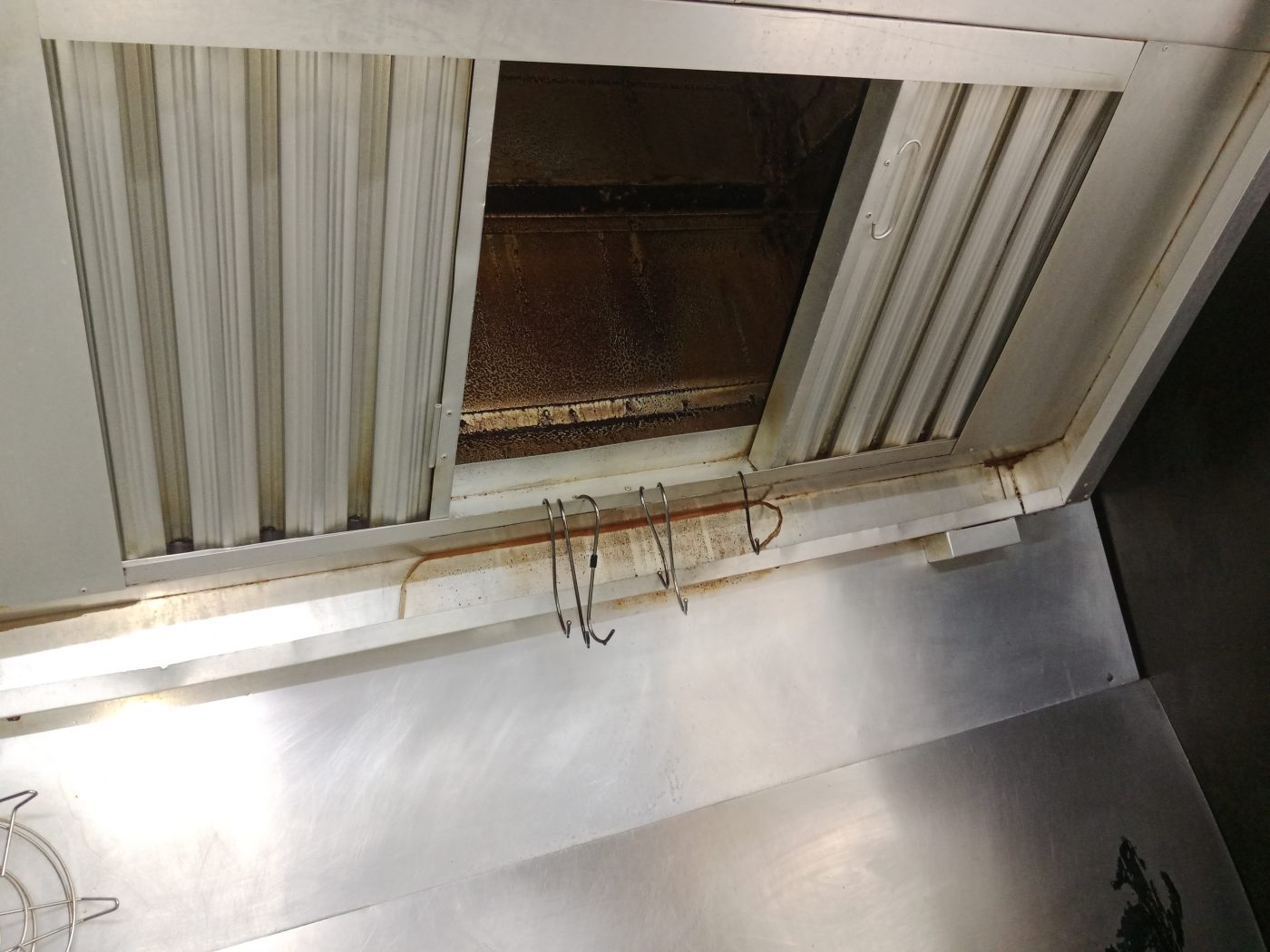
Pictured above: a kitchen hood at one of our projects (Tony Cafe, Adelphi), with one filter bay open. It is not a balancing job. It is reused here because the hood is where an airflow problem shows first, and it is the first thing anyone asks us about: smoke that will not go in, a canopy that seems to do nothing.
The kitchen is built, it has been trading for a while, and something about the air is wrong. Smoke rolls out of the front of the hood. The dining room smells of the line. The back door is heavy or slams. The air-conditioning cannot hold the room. Or one hood on a shared fan does all the work while another, a few metres down the run, does almost nothing.
Someone then says "get it modelled", and someone else says "get it balanced", and the operator, who just wants the smoke to go away, has no way to tell which is the right first move. This post is about that choice for a kitchen that already exists. We do both, CFD modelling and air balancing, for commercial kitchen ventilation, so the answer below is not a sales line for either. It is the order of events we would follow, and the questions you can put to anyone who quotes you.
The short answer
For a kitchen that is already built and underperforming, the usual first step is to measure what the system is actually doing, which is air balancing, and to bring in modelling afterwards if the readings do not explain the cause. That is how we describe it on our CFD modelling and air balancing page: an existing system that underperforms usually needs balancing first, sometimes with modelling to work out why. The reason is simple. A model predicts what a design will do. Your kitchen is not a design any more. It is a real system with a real duct, real grease in it and real doors, and the quickest way to learn what it does is to measure it.
What "measuring it" covers
Balancing is the measured, hands-on step. In a commercial kitchen it means:
- measuring exhaust and make-up airflow and comparing them with the figures the system was designed around;
- checking hood capture over the cooking line, with the equipment actually running;
- checking the pressure between the kitchen and the dining area, so the kitchen is neither starved of air nor pushing its air into the dining room;
- on a shared fan, measuring each hood, so you can see which one is taking the air and which one is being starved;
- adjusting what can be adjusted, and writing the readings down.
The last point matters more than it sounds. A reading on paper is a baseline. A year from now, "the exhaust seems weaker than it used to be" is an opinion without one, and a measurement against a known figure with one. We describe that side of the job in make-up air and air balancing.
Five things that change the readings, so check them before anyone measures
Balancing a system that is in the wrong state gives you readings that describe the wrong state. These are the things to know, or fix, first. None of them needs a tool.
- When it was last cleaned, and what was cleaned. Grease builds up inside the duct, resistance rises and airflow falls, and that only ever moves one way. Our published guidance is a clean every one to three months for most commercial kitchens, monthly for heavy wok, grill and deep-frying kitchens and quarterly for lighter ones. If the duct is well overdue, the airflow you measure is the airflow of a greased duct, and it will change again once it is cleaned. Tell whoever assesses you the date and the scope of the last clean.
- The filters. Are they all in, seated without gaps, and the same type across the bank? A mismatched or missing filter changes the resistance across the hood, and the fan and duct were sized around the original. See replacing a damaged baffle filter if one has gone missing.
- What was added. A new fryer, a bigger wok range, a relocated line. The hood and fan were sized for the line that existed on opening day. We cover that in adding cooking equipment to an existing hood.
- What is blowing across the line. A pedestal fan, an air-conditioning unit, a door that is propped open. Any of them can bend the plume past the hood edge, and it looks exactly like a weak exhaust. If smoke behaves better the moment a door opens, that points to make-up air, not the fan. See when a pedestal fan or air-con unit pushes smoke past the hood.
- The drive setting, if there is a variable speed drive. A drive is a control, not a cure. Turned down, capture falls. Turned up with no make-up air, the kitchen simply goes more negative. Write down what speed it is set to before anyone touches it.
Why a bigger fan is usually the wrong answer
It is the instinctive request, and it is the one we are asked for most. An exhaust fan can only remove air that is replaced from somewhere. Where make-up air is short, a bigger fan deepens the negative pressure and makes every one of those symptoms worse: the heavy doors, the lifted gas flames, the smell dragged in from the drain, the air-conditioning running flat out. That is why we look at exhaust, make-up air and pressure together, not one after another.
When modelling earns its place on an existing kitchen
CFD models how air, heat and smoke move through the space on screen. On an existing kitchen it is not the first tool, but there are three honest cases for it.
- The readings do not explain the cause. The exhaust and make-up figures look right, the pressure looks right, and the plume still escapes. Modelling can help work out why before anything is changed.
- A layout change is coming. A refit that moves appliances, adds a hood or opens the kitchen to the dining room is a design question again, and there you are back in the territory we describe in when a CFD ventilation study is worth paying for: open and show kitchens, heavy wok and fryer lines, and constrained shells.
- Several hoods interact. Where different appliances share one fan and one duct, the interaction between hoods is exactly what a model is good at showing. For the drift problem itself, see several hoods on one duct: why the balance drifts.
If you have a study in front of you already, how to read a CFD ventilation report covers what to check before you accept it.
The problem of figures nobody can find
Balancing means adjusting a system towards the figures it was designed to hit. An existing kitchen often has no commissioning record, and sometimes nobody can say what the design airflows were. A system balanced with no design intent to balance to is guesswork with a meter in its hand, so say plainly at the start if the figures do not exist. We start by assessing what the system is actually doing before recommending what to adjust, and the readings taken become the baseline you can hold it to afterwards. What you should ask is what the work will be held against, and whether you will get the readings in writing.
Five questions to put to whoever quotes you
- What will you measure, and in which conditions: which appliances running, doors open or shut, make-up air on?
- What will the readings be compared with: design figures, a commissioning record, or something else?
- Will you look at each hood on a shared fan, or only the main duct?
- Do I get the readings in writing, so there is a baseline next time?
- If the readings do not explain the problem, what happens next, and is modelling part of it?
Getting it looked at
If your kitchen already exists and is not performing, WhatsApp BC Air on 8989 2833 with the symptom, the number of hoods and what is under each, whether make-up air is provided, whether any design figures or commissioning record exist, the date of the last clean and anything that changed recently. A photograph of the hood front and the filters helps. We run a 24/7 standby line. We give no price in a post: every system is sized to the specific kitchen, and the quotation follows an assessment. For the service itself, see our CFD modelling and air balancing page.
The short version
- For a kitchen that already exists and underperforms, measure first: air balancing, then modelling if the readings do not explain the cause.
- Balancing measures exhaust and make-up air, hood capture and the kitchen-to-dining pressure, adjusts what can be adjusted, and records the readings as a baseline.
- Before anyone measures, know the date of the last clean, the state of the filters, what has been added, what is blowing across the line and the drive setting.
- A bigger fan is usually the wrong answer where make-up air is short.
- Say at the start if no design figures exist, and ask what the work will be held against.
Related reading: make-up air and air balancing · when a CFD ventilation study is worth paying for · several hoods on one duct · the exhaust is running but the kitchen is still smoky
Questions
Common questions
For an existing kitchen that underperforms, do I need air balancing or CFD first?
Usually air balancing first. It measures what the system is actually doing: exhaust and make-up airflow, hood capture and the pressure between kitchen and dining area. Modelling is brought in afterwards if the readings do not explain the cause, or if a layout change is coming.
What does an air balancing assessment measure in a commercial kitchen?
Exhaust and make-up airflow compared with the design figures, hood capture over the cooking line with the equipment running, and the pressure between the kitchen and the dining area. On a shared fan it also means looking at each hood, not just the main duct. The readings are written down as a baseline.
Will a bigger exhaust fan fix a smoky kitchen?
Not on its own. A fan can only remove air that is replaced. Where make-up air is short, a bigger fan deepens the negative pressure and makes heavy doors, lifting gas flames, smell in the dining area and an overworked air-conditioner worse. Exhaust, make-up air and pressure are looked at together.
What if nobody has the original design airflow figures for my kitchen?
Say so when you ask for an assessment. Balancing without design figures to balance to is guesswork, so ask what the work will be held against and whether you will get the readings in writing. The readings taken become the baseline to compare against later.
How much does air balancing or CFD modelling cost for an existing kitchen?
There is no fixed price. Every system is sized to the specific kitchen: the cooking line, the number of hoods, the duct run and the make-up air. Send the details on WhatsApp and the quotation follows an assessment.