23 Nov 2026 · Fire Safety
Two firms can look after one hood, but only if it is agreed in advance who isolates the suppression system before a clean and who re-arms it the same night, who checks every nozzle cap before the line is lit, who reports grease on the nozzles and fusible links, who tells the suppression servicer when the cooking line changes, who confirms the gas and power shut-off, and that both sets of reports are kept in one fire-safety file. The simplest fix is one coordinated visit that covers both.
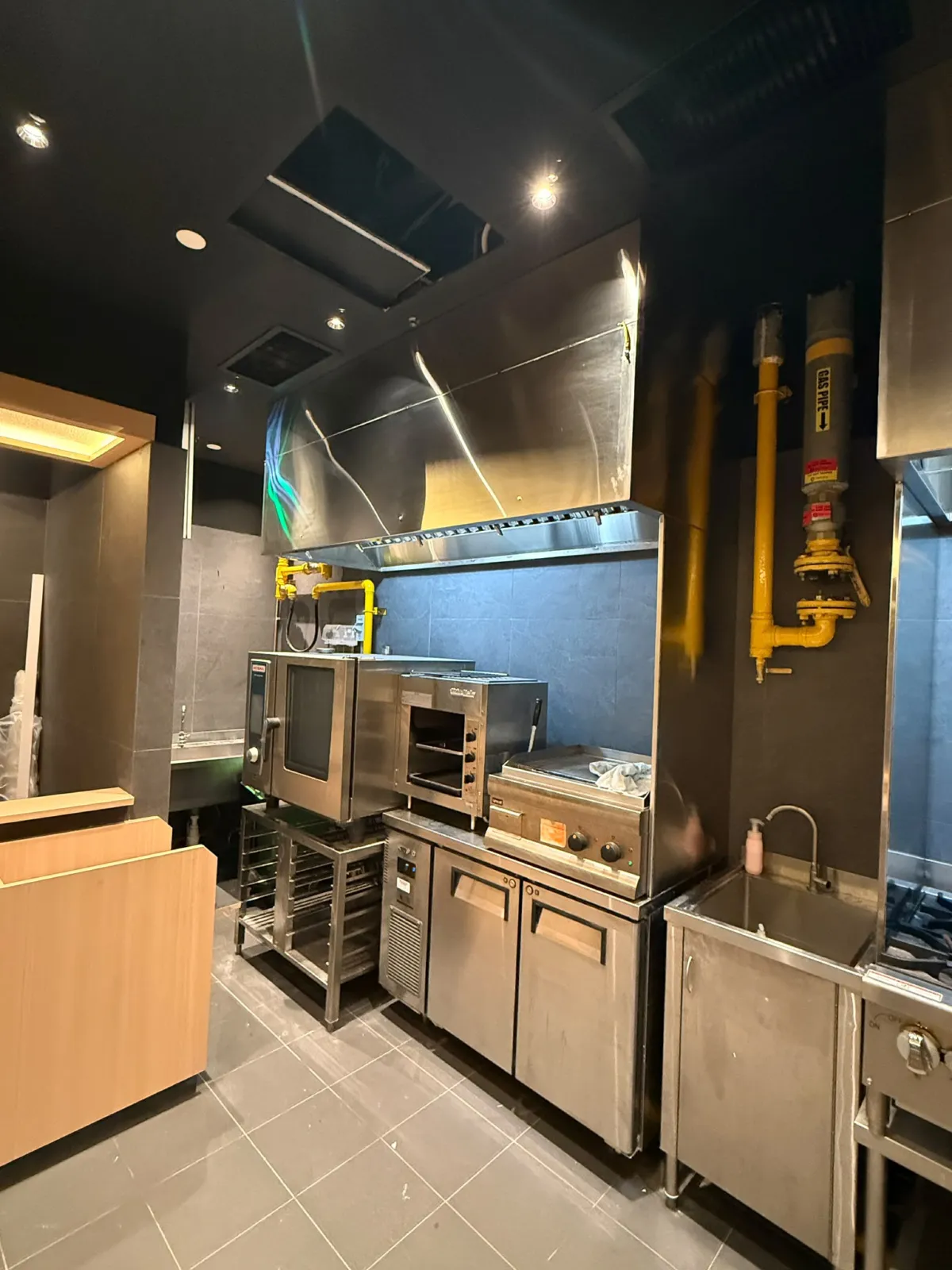
Pictured above: a new stainless hood over the left-hand cooking line at an F&B outlet fit-out, from BC Air’s Live Jobs page, with the yellow gas supply pipe beside it. The suppression pipework sits inside the canopy and cannot be seen from this angle. The photo is here because everything this post is about happens in that one space: the hood the exhaust cleaner works in, the line the suppression system protects, and the gas supply a discharge has to cut.
In a lot of Singapore kitchens the exhaust and the fire suppression system are looked after by two different firms. The suppression servicer was the installer, or the one the previous tenant used; the exhaust cleaner was chosen later. Each turns up on its own schedule and leaves its own report. On paper, both systems are maintained.
The trouble is that both firms work inside the same hood, over the same cooking line, and neither is responsible for what the other one does. The gaps open between the two jobs, not inside either of them. This post is for the owner or operations manager who has, or is about to have, two contractors on the hood. It sets out where those gaps are and the few things to agree so they close. It gives no price: servicing is quoted after an inspection of the actual system.
Two contractors can work, but only if somebody has agreed in advance who isolates the suppression system before a clean and who re-arms it, who checks the nozzle caps before the line is lit, who reports grease on the nozzles and fusible links, who is told when the cooking line changes, and where both sets of reports are kept. If nobody can answer those five questions, the gap is already there. The simplest way to close it is one coordinated visit that covers both, which is how we do it. If you keep two firms, the checklist at the end of this post is the minimum.
A suppression system is not a box on the wall. It lives in the dirtiest part of the kitchen: nozzles aimed at specific appliances, fusible links and detection over the line, pipework running along the canopy, and a release that cuts gas and electricity to the cooking line when it discharges. The exhaust cleaner works in exactly that space, right next to the detection and the nozzles.
And the grease is the same grease. The build-up we remove during an exhaust clean also fouls suppression nozzles and coats fusible links, and a link that is greased over can fail to release at the temperature it was rated for. So the condition of one system is partly decided by how well, and how often, the other is looked after. That is why we treat them as one job. When they are two contracts, the joins need to be agreed on purpose.
Where a suppression system is isolated so the crew can work inside the hood, someone has to put it back into service before anyone cooks. With one contractor, that is part of the same visit and goes on the same report. With two, it is common for the cleaner to assume the servicer will re-arm it, the servicer to assume the cleaner never isolated it, and the kitchen to assume everyone is finished because the crew has gone home.
The rule we work to is simple: a hood should never go back into service with its suppression still isolated because the paperwork was left for the morning. Agree before the first clean who is allowed to isolate the system, who re-arms it, and that the cleaning report records both. If the system was isolated, the report should say it was re-armed. What else to prepare for the night is in kitchen exhaust cleaning night: what to prepare and check.
Nozzles carry blow-off caps that keep grease out of the opening. A nozzle without its cap clogs with grease and may not discharge properly. Filters coming out, scraping inside the canopy and work in the plenum all happen within reach of the caps and the pipework. A cap knocked off on a cleaning night is nobody’s fault, but with two contractors it can easily be nobody’s job to notice.
Before the line is lit after a clean, someone should look up at every nozzle: caps on, pipework as it was, nothing hanging off a fitting. If a cap is missing or a fitting looks knocked, the call goes to whoever services the suppression system before cooking, not after. That “whoever” needs a name and a phone number the night supervisor can find.
The exhaust cleaner is the person most often looking at your nozzles and links up close, because the hood is open in front of them. If those components are caked in grease, the cleaner is the first to know, and often the only one who knows until the next suppression visit, which may be months away. But a cleaner who does not service the suppression system should not be wiping, scraping or spraying anything on it, and may not mention it at all, because it is “not our system”.
Ask the cleaner to photograph the nozzles and links on each visit and put a line in the report about what they saw. Then make sure that line reaches the suppression servicer. A greasy nozzle that two firms each saw and neither reported is the gap in its plainest form. What a supervisor can look at between visits, without touching anything, is in what a kitchen supervisor can check between suppression service visits.
The exhaust is cleaned on an interval set by your cooking; the suppression is serviced on an interval set for the system. With two contracts, the visits drift apart. The servicer may find greased nozzles a week before a clean and note it, and nothing changes until the cleaner returns. Or the clean happens, the nozzles are in easy reach, and nobody from the suppression side is there.
This is the practical reason we cover both on one coordinated visit: one team sees the whole cooking line, the nozzles and links get looked at while the hood is open, and neither job gets skipped. If you keep two firms, at least put both dates in one calendar and ask each to see the other’s last report before they come.
Suppression nozzles are aimed at particular appliances in particular positions. When a fryer is swapped for a bigger one, a griddle moves along, or a new appliance is squeezed in at the end, the coverage may no longer match the line. The exhaust cleaner is often the first outsider to see the change, because they are under the hood. The suppression servicer may not find out until their next visit, or at all.
Whoever changes the line should tell the suppression servicer before the next visit, not at it. Make that a standing instruction to the kitchen manager, and ask the cleaner to note any appliance that is new since the last clean. Why a small move can leave an appliance outside the coverage is in adding cooking equipment to an existing kitchen hood.
The gas and electrical shut-off interlock is the part of a suppression system that cuts fuel and power to the cooking line when it discharges. It is checked on a suppression service visit, and it is the item most often skipped. On a cleaning night the fan and the line may be switched off and back on, and the hood is opened up around the wiring. Ask the cleaner to record what they isolated and restored, and ask the suppression servicer, at the next visit, to confirm that the gas actually stops. The wiring side is in hood, fan, gas and suppression interlocks.
Every service visit should leave a dated record of what was checked, found and fixed, and every clean should leave a dated report with before-and-after photographs. With two firms, these often end up in two inboxes or two drawers. SCDF, your landlord, your insurer or an auditor may ask for either, and a documented service history kept beside your exhaust-cleaning records is the strongest evidence that the whole cooking line has been maintained. Keep both in one fire-safety file, in date order. What a proper suppression record should say is in what a suppression service visit should leave you with.
We clean kitchen exhaust systems and service fire suppression systems in-house, and we cover both on one coordinated visit rather than as two separate contracts, with each visit documented for your fire-safety file. We service suppression systems we did not install: if you have inherited a system with an unknown service history, we inspect it, tell you honestly what condition it is in, and set up a servicing schedule from there. What a servicing visit covers is on our fire suppression maintenance page, and the cleaning side is on kitchen exhaust cleaning. If you prefer to keep separate firms, the checklist above still applies, whoever does each job.
If you have two firms on the hood and want it looked at, WhatsApp BC Air on 8989 2833 with the location, the cooking line, who cleans the exhaust and who services the suppression now, and when it was last serviced, or that you do not know. We are on 24/7 standby, and we quote a clear rate after inspecting the system.
Related reading: what a suppression service visit should leave you with · checks between service visits · kitchen exhaust cleaning night
We design, clean, repair and maintain commercial kitchen exhaust systems across Singapore — on 24/7 standby.