
03 Nov 2026 · Troubleshooting
A grease film on the kitchen ceiling, walls or light fittings means some of the cooking plume is escaping the hood. Heaviest at the front edge of the hood points to capture; heaviest on one side or near a fan, door or vent points to air movement across the line; patchy stains away from the cooking area may be a duct leak. Photograph the pattern and find the cause, because wiping alone brings the film back.
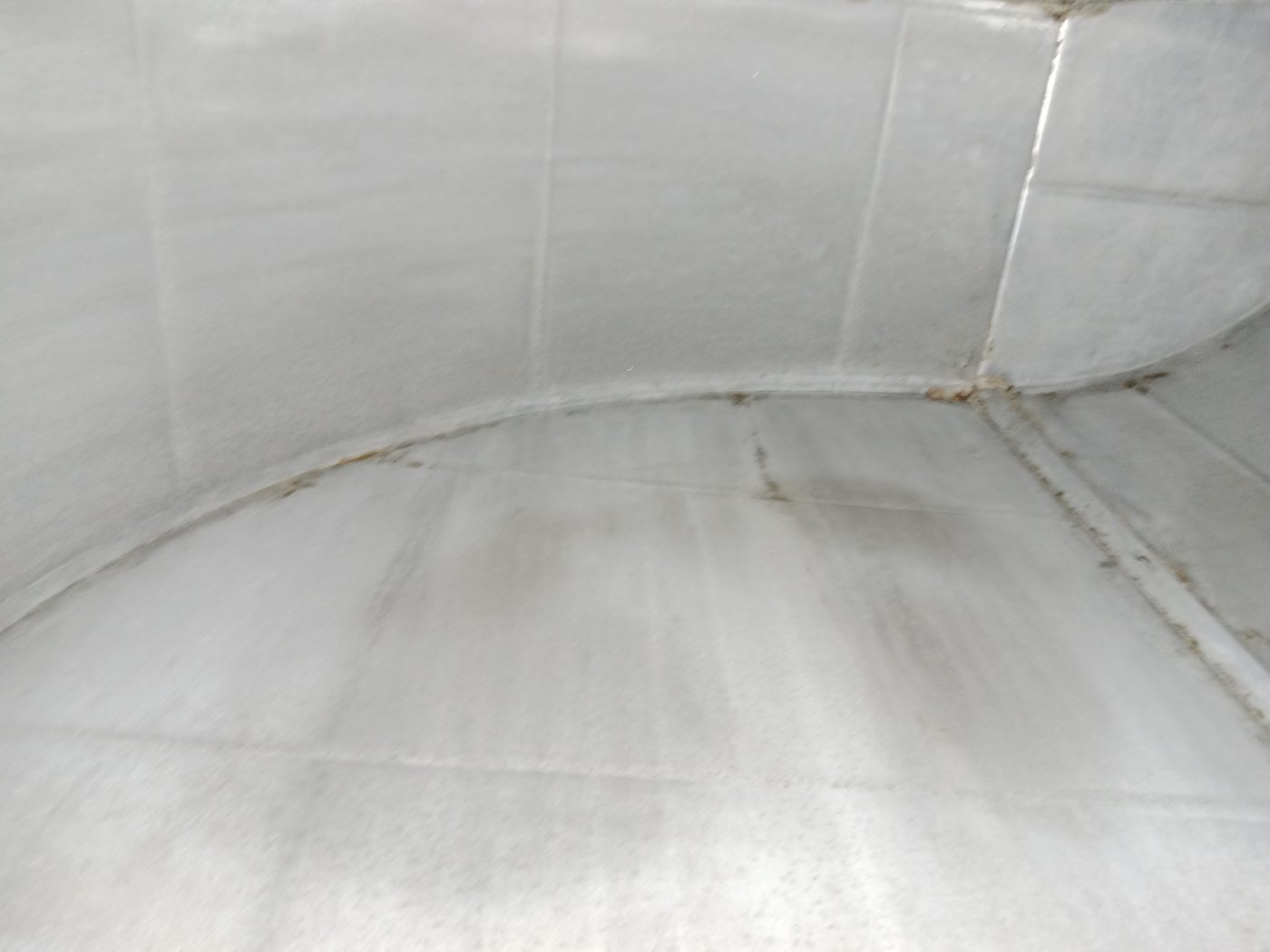
Pictured above: the inside of a duct run on one of our jobs (Tony Café, Adelphi). It is not a ceiling. It is reused here because it shows the quiet places grease settles once it has left the cooking line: seams, corners and joints, away from the surfaces anyone wipes.
Every kitchen has a film of grease somewhere. The question that matters is where it is. Grease on the hood and on the tiles right behind the cooking line is normal. Grease on the ceiling two metres away, on the light fittings at the far end, or on the wall by the pass is the kitchen telling you that some of what the cooking line produces is not being captured and taken out.
This post is for the owner or supervisor who has noticed a sticky, yellowing film on surfaces that are not part of the hood, and wants to know what it means before calling anyone. The film is a symptom. Where it sits is the clue, and reading the pattern costs nothing. It does not give a price: what is wrong decides what the fix is, and we quote after seeing the kitchen.
A film that is heaviest straight above and just outside the hood usually points to capture at the hood: the plume is getting past the canopy. A film that is heaviest on one side, or on whichever side a fan, door or air-con vent sits, usually points to air movement across the cooking line. A film that is patchy, with stains or drips on the ceiling of a different room, points to a leak in the duct run. And a film that keeps coming back soon after the ceiling has been wiped means the cause has not been touched.
Cooking throws off hot, grease-laden vapour. A hood is meant to hold that rising plume inside its canopy long enough for the fan to take it. What the hood does not hold goes up and spreads along the ceiling, cools, and settles. It lands on whatever is nearest and coolest, and it is sticky, so it collects dust and turns from yellow to brown over weeks.
This is the same grease we deal with inside the system. The difference is that out in the room nobody has a cleaning schedule for it. We have covered the wider case in why a kitchen can still be smoky with the exhaust running. This post is narrower: reading the film itself.
Do this when the kitchen is closed and cold, with a torch and your phone. Walk the room and note where the film is, and where it is not. Photograph each area with a tape measure or a hand in the frame so the distance from the hood is visible.
Look at the ceiling and the front face of the hood. If the film is thickest in a band running along the front edge, and the front of the canopy itself is stained or yellowed, the plume is rolling out under the front. The usual reasons are the ones the hood was never asked to cope with: a heavier appliance than the line was sized for, an appliance pushed to the end of the run so it sits half outside the canopy, or a table pushed forward. How a hood is matched to a line is set out in how we size a hood to the cooking line.
If one end of the ceiling is clean and the other is coated, ask what is blowing from where. A pedestal fan aimed at a cook, a split air-con unit blowing across the line, a back door left propped open: a modest sideways draught tips the rising plume out from under the canopy before the hood can take it. The film then lands in the direction the draught was pushing. This is covered properly in a fan or air-con blowing across the cooking line. If the film is worst at the far end from the hood but close to a door, look at where replacement air is coming from too: make-up air and air balancing explains how a starved kitchen loses grip at the hood.
Light fittings sit in the warm air that rises off the line, and their cool glass or cover is a good surface for vapour to settle on. A film here, with the rest of the ceiling reasonably clean, is often the earliest sign: it shows before the ceiling does. Treat it as an early warning, not a cosmetic job.
This is the pattern people misread. If the stain follows a line across the ceiling, or appears in the dining area or a corridor with no cooking underneath, it may be the duct. A duct runs through the ceiling void carrying hot, grease-laden air, and a failed joint, a loose access panel or a corroded section lets some of it out. The stain tends to follow the run of the duct and is heavier near joints and panels. What to do about a damaged section is in patch, replace a section or re-run it, and the panels are covered in duct access panels. If the smell reaches the dining area too, where the smell comes from lists the other routes.
Watch where the smoke goes. On the next busy service, ask someone to note where smoke and steam go in the first hour: do they climb into the canopy, or curl out at the front or one end? Ten minutes of watching tells you more than guessing from the film.
The hand test. With the line running, hold a hand at the front edge of the hood and at each end. You should feel a steady pull into the canopy. If one end feels dead, the film at that end is no surprise.
Surfaces in the room can be cleaned by the kitchen team or a general cleaner, and that is worth doing: a greasy film is a slip hazard on shelves and a fire load on the ceiling. But three cautions.
The exhaust clean we describe covers the system itself: canopy, filters, plenum, ducts and fan, with a written record afterwards. The ceiling tiles and wall surfaces in the room are not on that list. What a clean does is take the load off the system so that less escapes to land on them, and while we are inside it we note what we see, including signs that the hood is not capturing or that make-up air is short. Our published guidance is a clean every one to three months for most commercial kitchens, monthly for heavy wok, grill and deep-frying kitchens, and quarterly for lighter ones. We inspect the system and your cooking volume before recommending an interval. The schedule is explained on how often to clean a kitchen exhaust, and what the clean includes is on kitchen exhaust cleaning.
Whoever you call, give them the pattern, not just the complaint. “Greasy ceiling” could be five different faults. “The film is heaviest above the left end of the hood and on the wall behind the back door, and there is a pedestal fan on that side” narrows it to one. Send:
Do not leave it if the film is thick, dripping, or visible around the light fittings, if there is a stain on a ceiling that has no kitchen under it, or if a smell of old grease or hot dust comes from the hood with the line running. Grease in the wrong place is a fire load, and the hood is meant to carry it away, not leave it on the ceiling.
If you are not sure what the pattern means, WhatsApp BC Air on 8989 2833 with photos of where the film is worst, what you cook, the date of the last exhaust clean and what changed in the kitchen recently. We are on 24/7 standby. We give no price in a post: every kitchen is different, and the quotation follows a survey of the actual system.
Related reading: kitchen exhaust running but still smoky · a fan or air-con across the cooking line · duct access panels · make-up air and air balancing
We design, clean, repair and maintain commercial kitchen exhaust systems across Singapore — on 24/7 standby.