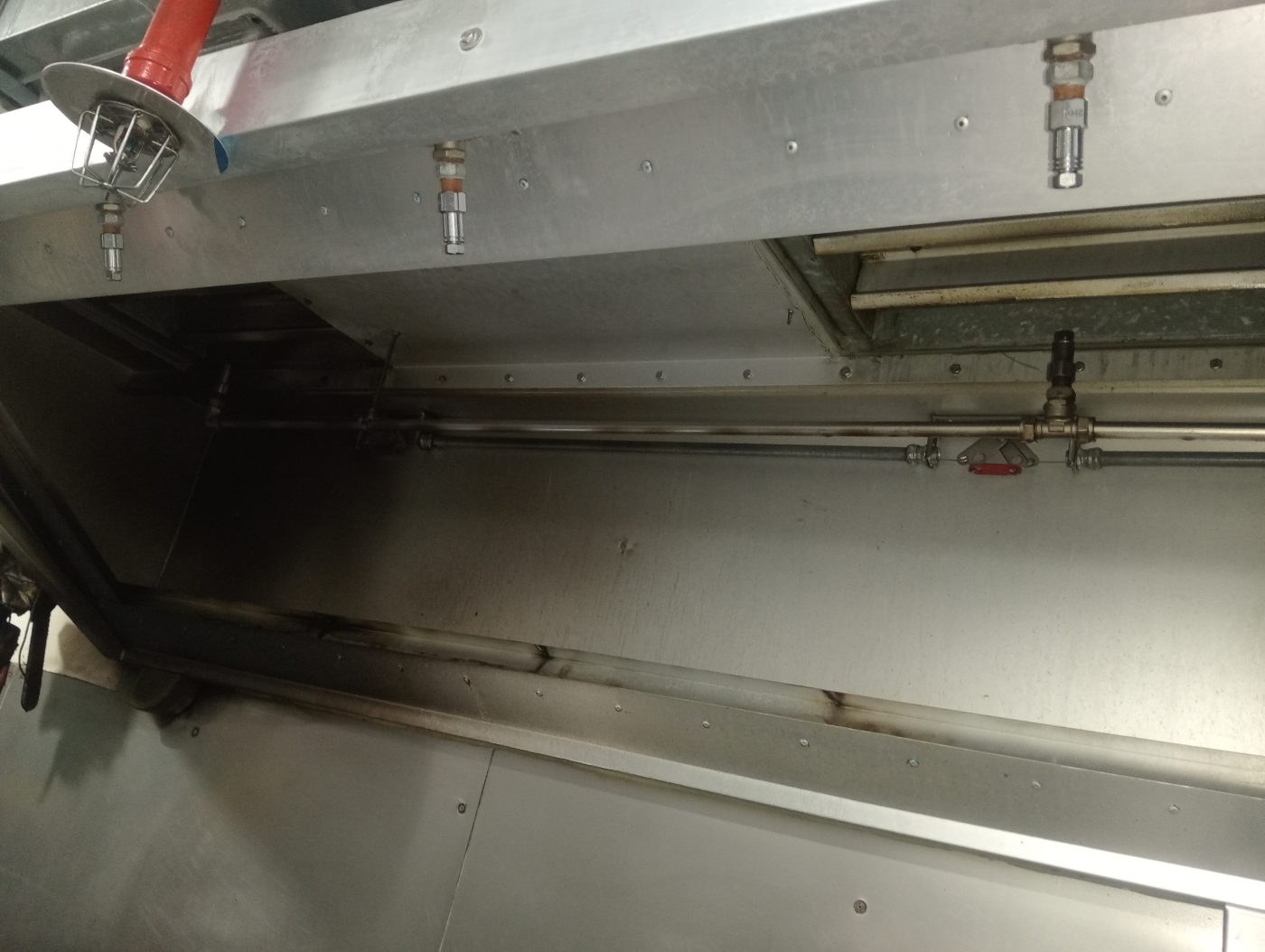
Pictured above: the inside of a hood canopy on one of our projects (Capitol). Looking up at the underside, the suppression pipework and nozzles run along the top and an opening sits at the upper right, while the dark lines of grease sit in the folds and joints along the lower edges. A wipe-down of the outside would never have touched any of it.
Most kitchens already pay someone to keep the premises clean: floors, drains, the bin area, the front-of-house stainless. When the exhaust hood starts to look dull, it is natural to ask that same company to do it as well. They are on site every week, they already know the kitchen, and one more line on the invoice is easier than finding a specialist.
Sometimes that works for part of the job. The trouble is that "cleaning the kitchen exhaust" means very different things depending on who writes the scope, and the part that is easy to see is not the part that causes the fire risk. This post sets out where a hood wipe-down ends and a duct clean begins, so you can read your own cleaner's quotation and know what it does and does not cover.
What a wipe-down gets you
The part of the exhaust that any cleaner can see is the hood: the stainless canopy and the filters sitting in the front of it. A general cleaner can wipe the outside of the canopy, degrease the surfaces in reach and make the front of the kitchen look right. That is useful, and it is part of what the kitchen team does between professional visits, as set out in what your kitchen team does daily.
The difficulty is that a bright hood says almost nothing about the system behind it. Grease collects at every stage of an exhaust system: across the filters, along the ductwork and inside the fan housing. What you can see from the floor tells you very little about what is above and behind it.
What a proper clean has to reach
BC Air publishes a 10-point kitchen exhaust servicing checklist so that any contractor's scope can be tested against it, ours included. Put your cleaner's quotation next to it and the gaps appear quickly. In summary, a proper service covers:
- The hood, inside and out. Not just a surface wipe-down of the visible stainless.
- The baffle filters, taken out and degreased. Never cleaned in place. Filters that come back shiny while the space behind them is untouched are a false comfort; see what is behind the baffle filters.
- The accessible ductwork, internally. The duct interior is where grease accumulates and where a fire travels. If the duct is not opened, it is not cleaned.
- The exhaust fan, opened and degreased. Grease on the blades unbalances the fan and wears out the bearings.
- The fan mechanicals, motor and control panel. Bearings, belts, vibration and balance, motor condition and connections, and a switching test, so that small wear is found before a breakdown in the middle of service.
- Airflow and capture at the hood, after the clean. A system can be clean and still underperform.
- The make-up air grilles. Exhaust only works when replacement air can get in.
- Before-and-after photographs and a service report.
Items two, three and four are the ones that decide whether the clean does anything about the grease that builds up out of sight, so they are the first lines to look for in any quotation, whoever is quoting.
The ten-minute test of any quotation
You do not need to be an engineer to check a scope. Ask whoever is quoting, in writing, the following.
- Which sections of the system does this price include? Hood, filters, duct, fan, make-up air grilles: each named, not "exhaust cleaning".
- Will the duct be opened? If there are no access panels along the duct, ask what they propose instead. A duct that cannot be opened cannot be cleaned inside, and the duct you cannot open is the duct that never gets cleaned.
- Who goes to the fan, and where is it? If nobody has ever asked where the fan sits, it has not been cleaned. For the roof, see grease on the roof around the exhaust fan.
- What happens to a section they cannot reach? A report that records a section as not accessible is the most useful line in the document. A report that has never named one deserves a question.
- What will you get afterwards? Dated before-and-after photographs from the same positions, taken inside the duct and at the fan as well as at the hood, and a written report.
- What if they find a fault? A worn bearing, a rough-running fan or a failed starter is a repair, not a cleaning item. Ask who deals with it and how quickly.
If the answers are vague, the price is probably for the hood alone. That may be what you want for the weeks between professional cleans. It is not what you want from the service that is meant to keep the system compliant and safe.
Why the record matters as much as the clean
An inspector, a landlord or an insurer will not look at your hood and judge it by its shine. What counts is a dated record: when the system was last cleaned, what was done, and what condition the duct was in. A kitchen whose cleaner wipes the hood weekly but cannot produce a report covering the duct and fan has a clean-looking hood and nothing to show.
That is the same gap we describe in changing your kitchen exhaust cleaning contractor: the operator has been paying for cleaning for years and has nothing to show for it except invoices. Every professional clean here comes with before-and-after photo documentation for landlords, audits and NEA inspections.
How often, and who does what
The interval follows what you cook. BC Air publishes that most commercial kitchens need cleaning every 1 to 3 months, that heavy wok, grill and deep-frying kitchens often need monthly cleaning and that lighter kitchens can run quarterly. The interval is set after inspecting the system, not by a fixed number. The cleaning frequency page explains how we decide.
A sensible split in most kitchens looks like this:
- Your general cleaner, weekly or daily: the outside of the hood, the surrounding surfaces, the floor under the cooking line, the grease cup if you agree it is part of their job.
- Your kitchen team, daily: filters washed on a routine, grease cup emptied, switching discipline, and a look behind one filter.
- The exhaust specialist, on the interval set for your menu: everything behind the filters: plenum, duct, fan, make-up air grilles, the mechanical check and the report.
Done well, the first two lists make the third cheaper and more predictable. They do not replace it.
Before you decide
- Pull the last cleaning report. Does it name the duct and fan, with photographs from inside them?
- Read your general cleaner's contract. Does the word "duct" or "fan" appear, or only "hood"?
- Look behind one baffle filter. If the plenum is coated, the filters are being cleaned and the system is not.
- Ask when the fan was last opened, and by whom.
- Check your landlord's requirements. Many commercial landlords ask tenants for cleaning records at set intervals; know what format they want before the next clean.
- Book the specialist clean for a closed period. We schedule cleaning overnight or during closed periods as a matter of routine, so you lose no trade; what to prepare and what to check afterwards covers the night itself.
Getting it done properly
WhatsApp BC Air on 8989 2833 with what you cook, who cleans the kitchen now, when the exhaust was last cleaned and what the last report said, and we will tell you what a proper first visit would need to cover. Our kitchen exhaust cleaning page sets out what the work includes, and the maintenance page covers the recurring arrangement. Because we stock motors, fans, fan parts and control components in-house, many repairs found during a clean can be done on the spot. Our crews are in-house and on standby 24/7. Scope and pricing follow an inspection of your system.
The short version
- A general cleaner can wipe the hood. That is not the same as cleaning the exhaust system.
- A proper clean opens the filters, the accessible duct and the fan, checks the mechanicals and records it all with photographs.
- If the duct is not opened, it is not cleaned. Ask what happens at any section that cannot be reached.
- Test any quotation against the published 10-point checklist, in writing.
- Keep the wipe-down for the weeks between visits; let the specialist clean on the interval set for your menu.
Related reading: what your kitchen team does daily · duct access panels · changing your cleaning contractor · behind the baffle filters
Questions
Common questions
Can our general cleaning company clean the kitchen exhaust?
They can usually wipe the hood and the surfaces around it, which is useful between visits. A proper exhaust clean also takes the baffle filters out and degreases them, opens and degreases the accessible ductwork and the fan, checks the fan mechanicals, motor and controls, and records the work with before-and-after photographs. Check the quotation against the published 10-point servicing checklist to see which of those it covers.
How do I tell whether my kitchen exhaust was really cleaned or only wiped down?
Look behind one baffle filter: if the plenum is coated with grease, the filters were cleaned and the system was not. Then read the last report. It should show photographs from inside the duct and at the fan, not only the hood, and it should name any section that could not be reached.
What should a kitchen exhaust cleaning quotation list?
Each section by name: hood, baffle filters, ductwork, exhaust fan and make-up air grilles, plus whether the duct will be opened, who goes to the fan, how a section that cannot be reached is recorded, and what documentation you get afterwards. A line that only says exhaust cleaning is not enough to compare.
How often should a commercial kitchen exhaust be professionally cleaned?
BC Air publishes that most commercial kitchens need cleaning every 1 to 3 months, with heavy wok, grill and deep-frying kitchens often monthly and lighter kitchens quarterly. The interval is recommended after inspecting the hood, duct and fan against the cooking volume and hours.
Does BC Air charge a fixed price for a kitchen exhaust clean?
No fixed figure is published. Scope and pricing follow an inspection of your system, because the cleaning depends on the hood, the length and access of the duct, and the fan.