
16 Aug 2026 · Design & Build
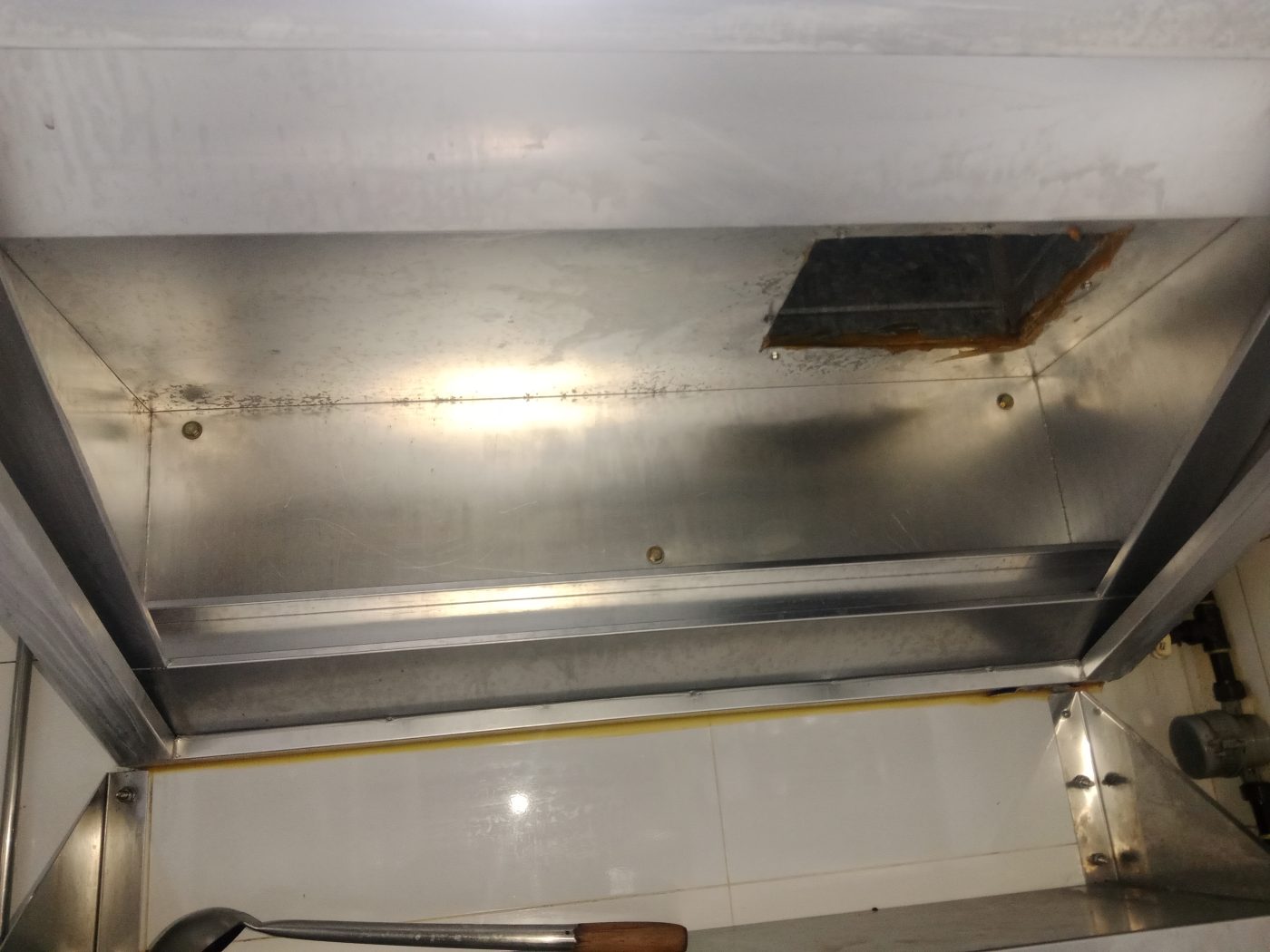
Coffee shop exhaust differs from restaurant exhaust in four ways: several stallholders share one duct and fan that no single party owns and maintains; stall cooking is high-heat and continuous, so grease loads faster than the floor area suggests; the duct was routed for the building rather than the stalls, giving long horizontal runs and bends that collect grease where access is hardest; and make-up air is usually inadequate, so smoke rolls out from under the hood while the fan runs hard. Set cleaning frequency by the heaviest stall, and fix incoming air before adding extraction.
A coffee shop or a hawker stall is not a small restaurant. It looks like one from the ventilation contractor's side — hoods, ducts, a fan — but almost everything that makes exhaust design difficult is different, and applying restaurant thinking to a coffee shop is how operators end up with a system that never quite works and a cleaning bill nobody expected.
The differences come down to four things: several tenants sharing one system, cooking that is heavier than the floor area suggests, a duct run that was designed for the building rather than for the stalls, and nobody owning the maintenance. Here is what each does in practice.
In a restaurant, one operator owns the kitchen, the hood, the duct and the fan, and one operator suffers when any of them is neglected. In a coffee shop, the hood over each stall may be effectively the stallholder's, the shared duct and the fan belong to the operator or the landlord, and the stallholders change over the years while the ductwork does not.
That split is the single biggest cause of neglected coffee shop exhaust systems. Each stallholder cleans what they can see — the filters and the visible part of the canopy — because that is what is theirs and what an inspection looks at first. The shared horizontal duct running above the ceiling, which is where grease actually accumulates and where a fire actually travels, belongs to everyone and therefore to no one.
If you operate or lease a coffee shop, settle in writing who is responsible for the shared duct and the fan, and how often it is cleaned. Doing this at the start of a tenancy is a five-minute conversation. Doing it after a grease fire is a dispute.
Stall cooking in Singapore is concentrated and intense. A single wok stall running through a lunch peak puts out more grease-laden vapour and more heat than a considerably larger Western kitchen doing plated food, because the cooking method is high-heat and continuous rather than intermittent.
Two consequences follow, and both are routinely underestimated:
That second point is worth dwelling on, because it is the most common complaint we hear and the least often diagnosed correctly. When a coffee shop is too hot and too smoky at once, the instinct is to ask for a bigger fan. A bigger fan often makes it worse. Which brings us to the part almost everyone gets wrong.
Every cubic metre of air pulled out of the premises has to be replaced by a cubic metre coming in. If it is not deliberately supplied, the building finds it anyway — under doors, through gaps, and from the dining area.
In a coffee shop this shows up in a very recognisable set of symptoms: smoke rolling out from under the front edge of the hood instead of going up it, a door that is heavy to open or slams, the dining area smelling of the stall furthest from the entrance, and the fan running hard while capture is visibly poor. All of those are one problem wearing four costumes.
Adding fan capacity to an already air-starved space increases the imbalance. The fix is to look at what is coming in, not only at what is going out. We wrote about this in more depth in make-up air and air balancing in a commercial kitchen, and the principle applies more sharply in a coffee shop than almost anywhere else, because the premises are usually more enclosed and more heavily cooked in per square metre.
Restaurant ductwork tends to be designed once, for one kitchen, with a reasonably direct route to the discharge point. Coffee shop ductwork frequently is not. It has to serve several stall positions, get around structure, and reach a discharge point the building already decided on, which often means long horizontal runs and more bends than anyone would choose.
Long horizontal runs matter because grease settles in them. Bends matter because they add resistance and collect deposits at the turn. Both mean that the parts of the system most in need of cleaning are the parts hardest to reach — and if access panels were not built in at the right intervals, cleaning becomes partial by default.
When a stall changes hands and the new tenant cooks differently — a drinks stall replaced by a fried food stall, say — the duct serving that position is now carrying a load it was never sized or routed for. That change is invisible on paper and very visible in the ductwork a year later.
The obligations do not scale down because the premises are small. A coffee shop still has to keep its exhaust system clean enough not to be a fire risk and not to be a nuisance to neighbours, and a fire in a stall still travels through the ductwork the same way it does anywhere else. The two posts worth reading alongside this are what NEA expects from your kitchen exhaust system and how a grease fire travels up kitchen ductwork.
Odour complaints deserve their own mention, because coffee shops attract them more than restaurants do. They tend to sit closer to residential blocks, they cook for longer hours, and the discharge point is often lower and nearer to windows. A complaint is usually a discharge and design problem rather than a cleaning problem, and cleaning alone rarely settles it.
A coffee shop concentrates heavy cooking into a small, enclosed, shared space with ductwork that was routed for the building rather than the stalls, and with no single person responsible for the part that matters most. Fix the ownership question and the make-up air question first — most of the rest follows from those two.
Tell us how many stalls share the system and what the heaviest one cooks, and we will tell you what the interval should be and whether the layout is working against you. Message us on WhatsApp, or see kitchen exhaust cleaning and commercial kitchen ventilation.
Related: another kitchen type the wok-line rules of thumb do not fit - bakeries and oven-led kitchens.
Where the stalls sit inside an institution rather than a coffee shop, the arrangement changes again — see kitchen exhaust in a school or institutional canteen.
We design, clean, repair and maintain commercial kitchen exhaust systems across Singapore — on 24/7 standby.