
25 Jul 2026 · Fire Safety
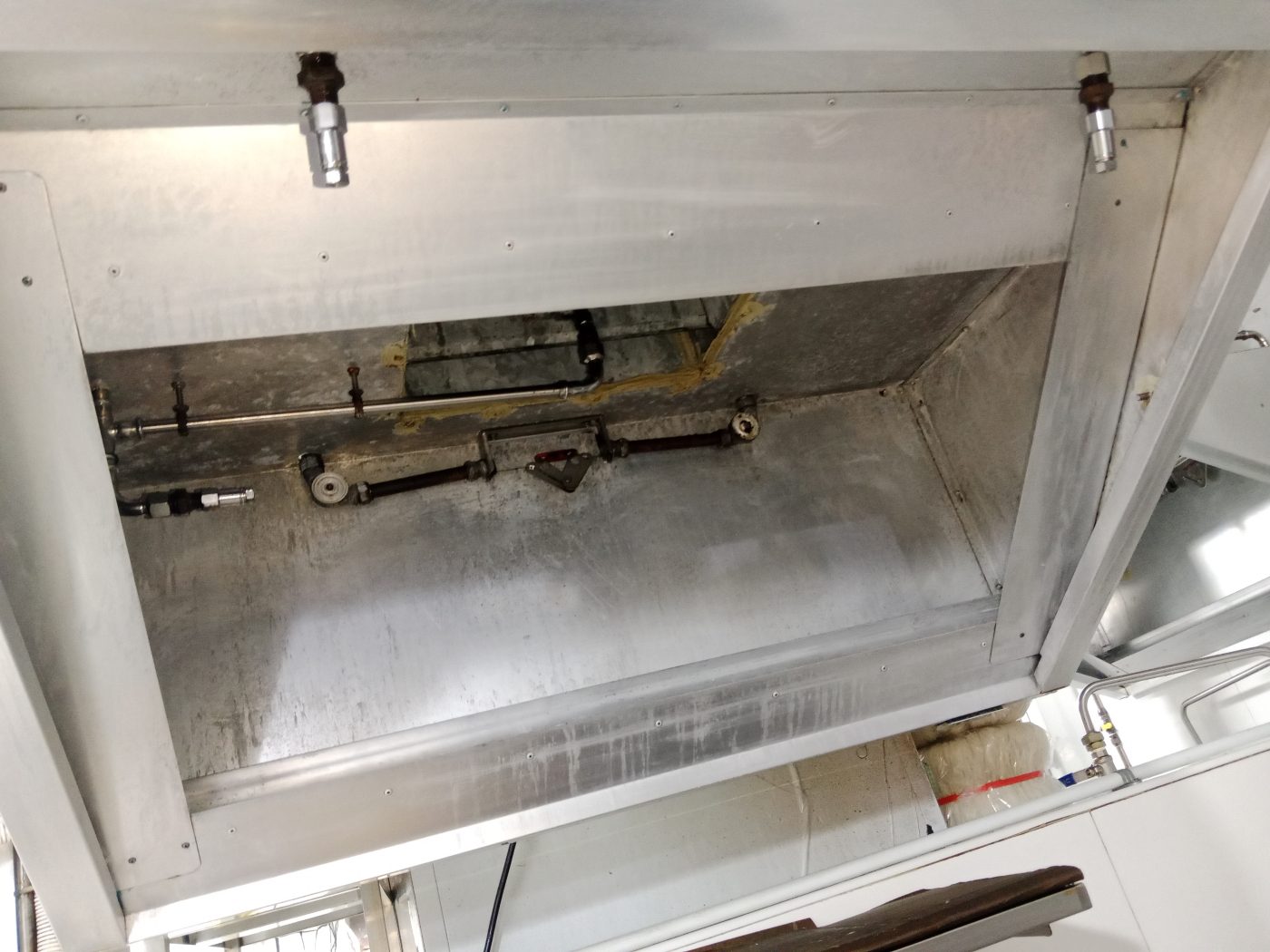
Commercial kitchen fire safety works in three layers: keeping exhaust ducts and hoods grease-free, having a certified suppression system ready to act, and ensuring fire-rated enclosures contain any outbreak. Skipping any layer leaves the others exposed. We design and maintain all three — in-house, no subcontractors.
Kitchen fires rarely announce themselves. What we see, again and again, is that the risk builds slowly — grease loading up in a duct over months, a suppression nozzle quietly blocked by cooking residue, a fire-rated panel that was never properly sealed after a contractor ran new cabling through it. By the time something ignites, the gap in the protection is already old. That is why we talk to every client about fire safety as a layered system: clean first, suppress second, contain third. Each layer depends on the others, and a weakness in any one of them puts the whole kitchen at risk.
Cooking oils and animal fats aerosolise the moment they hit a hot enough surface. That vapour travels upward into your canopy hood, through your exhaust plenum, and along every metre of ductwork on its way to the discharge point. As it cools against metal surfaces, it condenses and sticks. Do this for enough service hours and you are left with a thick, continuous fuel source running from the wok station all the way to the roof.
We have opened ducts on busy hawker kitchens and found grease deposits several centimetres thick — tacky enough to hold its shape when you press a finger into it. That material has an ignition point well within the range of a grease fire that escapes a wok or fryer. Once it catches inside a duct, the fire travels faster than any brigade can respond, and the duct itself acts as a chimney, drawing in air and feeding the burn.
This is why exhaust cleaning is not a housekeeping task. It is your first line of fire defence.
The honest answer is: it depends on your cooking load, your fuel type, and your menu. A high-volume wok kitchen running on charcoal or wood fire generates far more grease-laden vapour per hour than a bakery or a light Western kitchen. We assess grease loading during our first inspection and recommend a cleaning frequency from there — which might be monthly for a 24-hour dim sum kitchen, or quarterly for a lower-volume café operation.
NEA has guidelines on exhaust maintenance for food establishments, and SCDF references duct cleanliness as part of fire safety requirements for commercial kitchens. We always confirm the exact requirement with the relevant authority before quoting, because the rules do get updated and we would rather give you accurate advice than a confident wrong answer.
What we can say with certainty is this: a documented, regular cleaning schedule is your proof of compliance and your proof of due diligence if anything ever goes wrong. We issue a service report with every clean, timestamped and detailed, so you have a paper trail.
We use our own BC Air chemical series for degreasing — formulated for commercial kitchen grease, not domestic cleaning product adapted for the job. Our technicians access the full duct length, not just the sections visible from the kitchen. We photograph before and after, and we flag anything structurally concerning while we are inside the system.
A kitchen fire suppression system is your second layer. It sits in the hood above your cooking appliances, with nozzles positioned to flood a fire with wet chemical agent the moment a thermal sensor or manual trigger activates it. Done correctly, it knocks the fire down before it has a chance to enter the ductwork at all.
But suppression systems are not passive. They need maintenance. Nozzles get clogged with grease. Pressure drops in cylinders go unnoticed. Fusible links — the heat-sensitive triggers — can be painted over during a kitchen repaint, which effectively blinds them. On one kitchen we serviced, we found a suppression nozzle that had been wrapped in cling film by a well-meaning kitchen worker who wanted to keep it clean. It would not have discharged at all.
We do not install suppression systems independently of our exhaust work. We inspect them as part of our service visits because we are already inside the hood. If we see something that concerns us, we tell you plainly and we can coordinate with your suppression contractor or refer you to someone qualified to rectify it.
The key point is that suppression only works reliably on a clean system. If the duct above the hood is heavily loaded with grease, a suppression discharge may extinguish the immediate cooking fire but do nothing to stop a secondary ignition inside the duct itself. Cleaning and suppression are not alternatives to each other — they are partners.
Even with clean ducts and a working suppression system, fire containment is your final safety net. This is about the physical construction of your kitchen envelope: fire-rated walls, dampers inside your ductwork, proper sealing around any penetrations, and the integrity of your exhaust riser if you share it with other tenants in a commercial building.
A fire damper inside a duct is designed to close automatically when it detects elevated heat, preventing fire from travelling through the ductwork into adjacent spaces or floors. These dampers need to be tested periodically — they can seize in the open position if never exercised, which means they would not close when actually needed. We inspect damper condition and accessibility during our duct cleaning work.
Every time a duct passes through a fire-rated wall or floor, that penetration needs to be properly fire-stopped. We have seen buildings where good ductwork runs through gaps that were never reinstated after installation — effectively creating an open path for fire and smoke between floors. For new installations, we design and fabricate our duct enclosures in-house to meet the required fire rating, and we document the specification clearly for BCA and SCDF purposes.
If your kitchen exhausts into a shared riser, you carry a responsibility not just to yourself but to every other tenant connected to that system. Grease from your kitchen migrates upward and can coat the internal surfaces of a shared duct, creating risk that your neighbours neither caused nor can control. We advise any client in a shared-riser building to be especially consistent about cleaning schedules and to keep documentation available.
When a new client engages us — whether for a single restaurant or an entire hotel kitchen block — we start by walking the full exhaust path from canopy to discharge. We look at grease loading, duct condition, access panel placement, damper locations, suppression nozzle positioning, and the fire rating of the enclosure. From that walk, we put together a clear picture of which layer needs the most immediate attention and what a sustainable maintenance programme looks like.
We carry out all this work in-house. Our engineers design, our fabricators build, our cleaning teams service, and our 24/7 standby team respond when something urgent comes up after hours. There is no handoff to a subcontractor and no gap in accountability between what was specified and what was installed.
The clearest signs are a visible grease film around your canopy filters, a strong persistent odour even when the exhaust is running, and a history of infrequent or undocumented cleaning. If you cannot produce a recent service record showing the full duct length was cleaned — not just the filters — we would treat that as an immediate concern. Call us and we will do an inspection. We have seen kitchens that looked clean from the cooking line but had serious grease loading just half a metre into the duct.
No. Cleaning reduces the fuel load in your ductwork; suppression extinguishes a fire at the cooking surface before it can enter the duct. They address different stages of a fire event. NEA and SCDF requirements also treat them separately — you need both, maintained to standard. We are always direct with clients about this: cleaning without suppression leaves you exposed, and suppression without cleaning may not be enough to stop a duct fire once grease has accumulated.
We run 24/7 standby. If you call us at 2 a.m. because your exhaust fan has seized, or you have had a fire event and need an emergency duct inspection before reopening, we can mobilise. We keep motors, MV fans, control panels and variable speed drives in stock, so we are not waiting on a supplier before we can fix something. Our goal is always to get your kitchen back to a safe, operational state as fast as possible.
Every service visit produces a written report: what was found, what was done, any defects or recommendations noted, and photographic evidence of the duct before and after cleaning. This documentation is what you present to NEA, SCDF or your landlord if they ask for proof of maintenance. We date and sign every report, and we keep copies on our end so there is a consistent record over time.
Yes. We design and fabricate in-house, which means we can build duct enclosures to the required fire rating and document the specification for building authority purposes. We understand the requirements around penetration sealing and fire dampers, and we work within BCA and SCDF frameworks. If a project has specific requirements we need to confirm with the relevant authority, we tell you upfront rather than assuming.
If you are not confident that all three layers of your kitchen fire safety are in good shape, the right move is a proper inspection — not a quick look at the filters. Get in touch with us for a full assessment and quotation; we will walk the system with you and give you a straight answer on where the gaps are. Our 24/7 standby means we are available whenever your kitchen needs us, not just during office hours.
Going deeper: for the suppression layer specifically, what drives the cost of a kitchen fire suppression system.
Related: the containment layer in detail — when your kitchen exhaust duct has to be fire-rated.
We design, clean, repair and maintain commercial kitchen exhaust systems across Singapore — on 24/7 standby.